Teaching
Courses and Programs
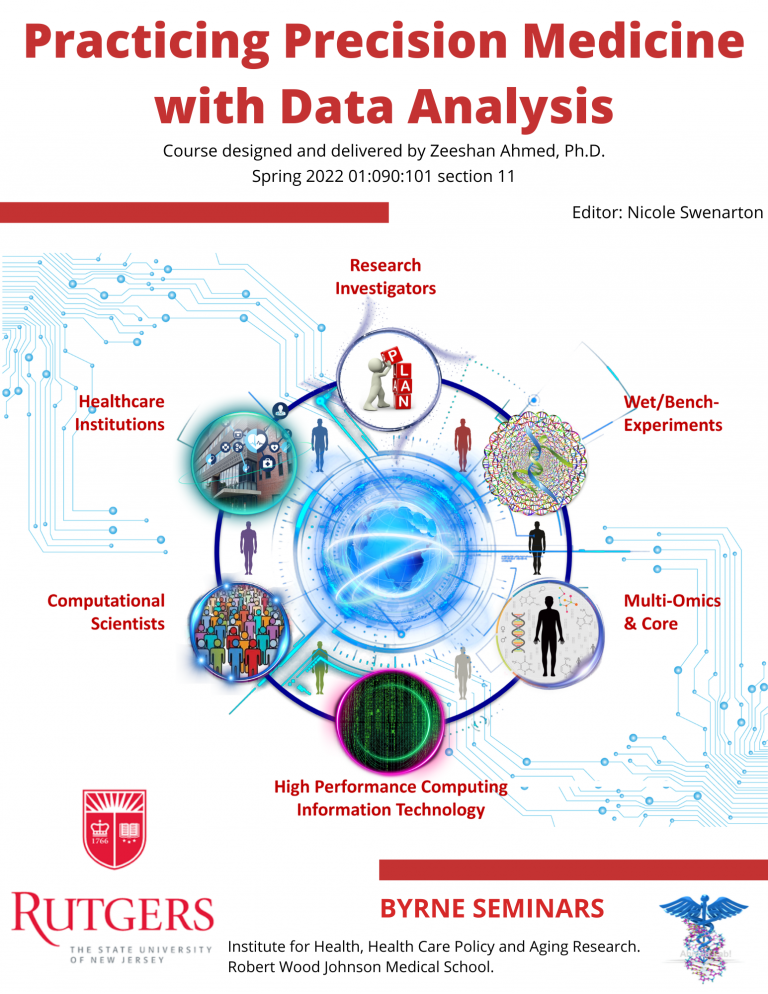
Practicing precision medicine with data analysis.
Precision medicine aims to empower clinicians to predict the most appropriate course of action for patients with complex diseases, and improve routine medical and public health practice. However, practicing precision medicine is not straightforward, as significant efforts are required from the experts in multidisciplinary sciences. In this course, I was focused on discussing three important areas that heavily contribute to the development of precision medicine initiatives, 1) understanding complexities of Electronic Healthcare Records; 2) bioinformatics applications for genomics data analysis; and 3) intelligent and integrative data analysis with machine learning algorithms. Overall syllabus is based on following topics:
- Practicing Precision Medicine with Data Analysis.
- Introduction to Electronic Health Systems and Clinical Data Analysis.
- Introduction to Genomic and Transcriptomics, and Sequence Data Analysis.
- Human Gene and Disease Associations for Clinical-Genomics & Precision Medicine.
- Sequence data processing, management, and gene-variant discovery, annotation, prediction, and genotyping.
- Case Study: Gene-Variant Analysis.
- Bioinformatics applications for variable gene-disease annotation, visualization, and expression analysis.
- Case Study: Gene-Disease Data Annotation and Expression Analysis.
- Artificial intelligence and machine learning techniques for better healthcare and genomics medicine.
- Multi-omics strategies for personalized and predictive medicine: past, current, and future.
Success story of “Practicing precision medicine with data analysis” (ID: 01:090:101 section 11).
Active participation helped students in learning about the operational and academic medical systems, intelligently linking curated clinical data with computationally processed genomic data to identify functional variants among expressed genes, and investigating genotype and phenotype associations. This course was grouped with theoretical discussions, basic and life science concepts, and computational skills. Full class of students was originated and formalized due to good response of students. All students worked hard, and with the collective efforts of all the students, in the end of this course we were able to compile a manuscript, which has been published in one of the well reputed journals with very good impact factor i.e., Frontiers in Genetic:
- Abdelhalim, H., Berber, A., Lodi, M., Jain, R., Nair, A., Pappu, A., Patel, K., Venkat, V., Venkatesan, C., Wable, R., Dinatale, M., Fu, A., Iyer, V., Kalove, I., Kleyman, M., Koutsoutis, J., Menna, D., Paliwal, M., Patel, N., Patel, T., Rafique, Z., Samadi, R., Varadhan, R., Bolla, S., Vadapalli, S., & Ahmed, Z*. (2022). Artificial Intelligence, Healthcare, Clinical-Genomics, and Pharmacogenomics Approaches in Precision Medicine. Section: Computational Genomics. Research Topic: Artificial Intelligence for Personalized and Predictive Genomics Data Analysis. Frontiers in Genetics. 13, 929736. PMID: 35873469. (Frontiers)
Other Courses and Programs at Rutgers:
-
RWJMS Coaching Program
-
HONORS TUTORIAL (I, II, III, IV, V)
-
Student to Professional Internship Network (SPIN)
-
Research Problems in Biochemistry
-
Advanced Independent Study in Genetics
-
Ethical Scientific Conduct Initial training (Course director: Janet Alder)
Special Courses:
-
Biomedical Data Science and Health AI training.Rutgers University, 2025.
-
Module on Emerging Technologies – GWA. Rutgers University, Princeton University, and New Jersey Institute of Technology, 2025.
-
Harnessing Big Data and Precision Medicine Intelligent & Integrative Data Analysis for Health Impact. Centers for Disease Control and Prevention (CDC) & Oak Ridge Institute for Science and Education, 2023.
Practicing precision medicine with data analysis.
Precision medicine aims to empower clinicians to predict the most appropriate course of action for patients with complex diseases, and improve routine medical and public health practice. However, practicing precision medicine is not straightforward, as significant efforts are required from the experts in multidisciplinary sciences. In this course, I was focused on discussing three important areas that heavily contribute to the development of precision medicine initiatives, 1) understanding complexities of Electronic Healthcare Records; 2) bioinformatics applications for genomics data analysis; and 3) intelligent and integrative data analysis with machine learning algorithms. Overall syllabus is based on following topics:
- Practicing Precision Medicine with Data Analysis.
- Introduction to Electronic Health Systems and Clinical Data Analysis.
- Introduction to Genomic and Transcriptomics, and Sequence Data Analysis.
- Human Gene and Disease Associations for Clinical-Genomics & Precision Medicine.
- Sequence data processing, management, and gene-variant discovery, annotation, prediction, and genotyping.
- Case Study: Gene-Variant Analysis.
- Bioinformatics applications for variable gene-disease annotation, visualization, and expression analysis.
- Case Study: Gene-Disease Data Annotation and Expression Analysis.
- Artificial intelligence and machine learning techniques for better healthcare and genomics medicine.
- Multi-omics strategies for personalized and predictive medicine: past, current, and future.
Success story of “Practicing precision medicine with data analysis” (ID: 01:090:101 section 11).
Active participation helped students in learning about the operational and academic medical systems, intelligently linking curated clinical data with computationally processed genomic data to identify functional variants among expressed genes, and investigating genotype and phenotype associations. This course was grouped with theoretical discussions, basic and life science concepts, and computational skills. Full class of students was originated and formalized due to good response of students. All students worked hard, and with the collective efforts of all the students, in the end of this course we were able to compile a manuscript, which has been published in one of the well reputed journals with very good impact factor i.e., Frontiers in Genetic:
- Abdelhalim, H., Berber, A., Lodi, M., Jain, R., Nair, A., Pappu, A., Patel, K., Venkat, V., Venkatesan, C., Wable, R., Dinatale, M., Fu, A., Iyer, V., Kalove, I., Kleyman, M., Koutsoutis, J., Menna, D., Paliwal, M., Patel, N., Patel, T., Rafique, Z., Samadi, R., Varadhan, R., Bolla, S., Vadapalli, S., & Ahmed, Z*. (2022). Artificial Intelligence, Healthcare, Clinical-Genomics, and Pharmacogenomics Approaches in Precision Medicine. Section: Computational Genomics. Research Topic: Artificial Intelligence for Personalized and Predictive Genomics Data Analysis. Frontiers in Genetics. 13, 929736. PMID: 35873469. (Frontiers)
Other Courses and Programs at Rutgers:
-
RWJMS Coaching Program
-
HONORS TUTORIAL (I, II, III, IV, V)
-
Student to Professional Internship Network (SPIN)
-
Research Problems in Biochemistry
-
Advanced Independent Study in Genetics
-
Ethical Scientific Conduct Initial training (Course director: Janet Alder)
Special Courses:
-
Biomedical Data Science and Health AI training.Rutgers University, 2025.
-
Module on Emerging Technologies – GWA. Rutgers University, Princeton University, and New Jersey Institute of Technology, 2025.
-
Harnessing Big Data and Precision Medicine Intelligent & Integrative Data Analysis for Health Impact. Centers for Disease Control and Prevention (CDC) & Oak Ridge Institute for Science and Education, 2023.